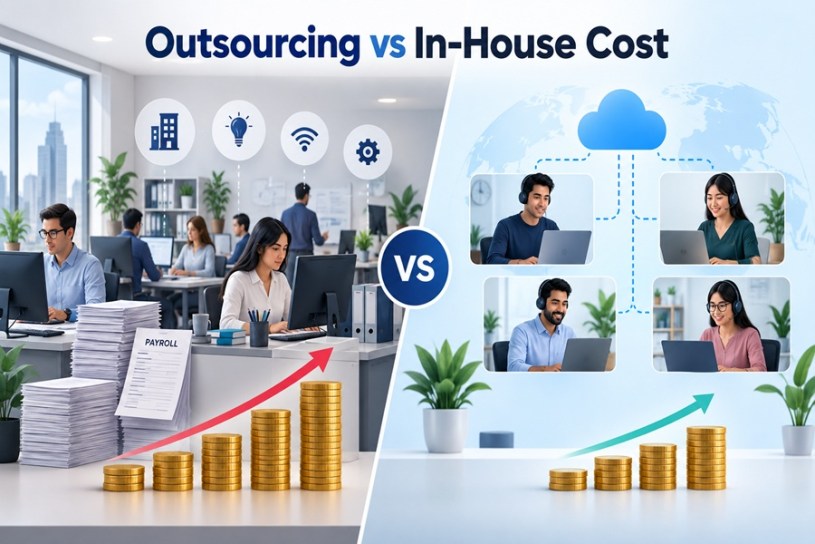
“Outsourcing is cheaper” is one of the most repeated pieces of business advice — and it’s only half true. Outsourcing is usually cheaper for the right kind of work. For the wrong kind, it quietly becomes the more expensive option, just with the costs hidden in different places.
The True Cost of an In-House Hire (It’s Not Just Salary)
A common mistake is comparing an outsourcing quote directly against an employee’s salary. That’s not an apples-to-apples comparison. The real cost of an in-house employee includes:
- Base salary
- Benefits and payroll taxes
- Recruiting and onboarding time
- Equipment, software, and tools
- Office space and overhead
- Manager time spent supervising
- Training time before they’re productive
- Turnover risk and replacement cost if they leave
As a concrete example cited by business finance advisors: a $70,000 staff role can actually cost a business $98,000–$126,000 per year once fully loaded costs are included — 40–80% more than the salary alone suggests.
The Hidden Costs of Outsourcing (That Vendors Don’t Advertise)
Outsourcing has its own invisible costs that rarely show up in the initial pitch:
| Hidden Cost | What It Looks Like |
|---|---|
| Vendor management overhead | Someone internally must manage the relationship — often 10–20% of the vendor fee |
| Transition costs | Knowledge transfer, system access setup, parallel-running periods |
| Quality risk / rework | Cheap providers can create errors that require expensive expert time to fix |
| Communication friction | Time zone gaps, language barriers, tool mismatches slow everything down |
| Turnover on the vendor’s side | Losing a familiar outsourced contact resets the learning curve |
The classic trap: an $8/hour outsourced worker makes errors that require $50/hour specialist time to correct. At that point, nothing was actually saved.
When Outsourcing Genuinely Wins
Outsourcing tends to be the smarter economic choice when:
- Workload is uneven or seasonal — you don’t need full-time capacity year-round
- Speed matters more than deep integration — you need output fast, not a long-term team member
- The work is repeatable and execution-heavy — reporting, research support, data maintenance, CRM updates
- You lack in-house expertise and building it would take too long
- You need to scale capacity without proportional headcount cost — some estimates put this advantage at 40–60% for cost-sensitive scaling
When In-House Hiring Wins Instead
The advice flips in these situations:
- The function needs ongoing, specialized, and expensive support — marketing is a commonly cited example, where a generalist in-house hire is often more affordable than fully outsourcing everything to an agency
- Utilization is consistently high — if someone would be doing this work full-time anyway, the fixed cost of hiring gets absorbed efficiently
- The work requires deep business context — close integration with company strategy, culture, or proprietary systems favors an internal hire
- You need someone available immediately for critical functions — outsourced support can introduce lag during urgent situations
- You’re building something proprietary — unique algorithms, custom architecture, or IP-sensitive work benefits from full internal ownership
A Practical 3-Year Comparison Framework
Rather than comparing hourly rates, build a simple side-by-side model that captures total cost, not just visible cost:
- In-house total cost = salary + benefits + recruiting + tools + training + management time + turnover risk
- Outsourced total cost = vendor fee + management overhead (10–20%) + transition cost + rework/quality risk + communication friction
Whichever number is genuinely lower over the full period, not just in year one, is usually the better financial decision.
Quick Decision Checklist
- Is the workload steady and high-utilization? → Lean in-house
- Is the workload variable or seasonal? → Lean outsourcing
- Does the role need deep company/product context? → Lean in-house
- Is the task repeatable, rules-based, and well-documented? → Lean outsourcing
- Do you have someone internally to manage a vendor relationship well? → If no, factor in that hidden cost before outsourcing
Frequently Asked Questions
Is outsourcing always cheaper than hiring?
No. It’s typically cheaper for variable, repeatable, or specialized short-term work, but it can become more expensive than hiring once vendor management, rework, and communication friction are added in.
What’s the biggest hidden cost of outsourcing?
Quality risk and rework. A cheaper provider that produces errors can end up costing more in specialist correction time than a slightly pricier, more reliable option would have.
What’s the biggest hidden cost of hiring in-house?
Total loaded cost beyond salary — benefits, recruiting, training, tools, and turnover can add 40% or more on top of the stated wage.
How do I decide for my specific business?
Build a simple 3-year total-cost comparison for both options, including the hidden costs listed above, rather than comparing a salary figure to a vendor quote.

